
14.25 million people applied for a US nonimmigrant visa in FY2024. Over three million were refused. For Indian F-1 applicants the refusal rate hit 61% in 2025 — a ten-year high — and India's B1/B2 rate went from 16.32% to 22.04% in a single year.
And still, more than a million Indians got their visas.
So it isn't luck. When I built Permito's AI interviewer I went through thousands of interview patterns, and the same small set of mistakes keeps surfacing — money answers with no numbers in them, a return plan nobody believes, a story that quietly contradicts the DS-160 two questions later. Most of it is fixable in an evening. The problem is that almost nobody finds out which parts of their own answers are the weak ones until an officer is already looking at them.
Ready to practice before your interview?
Try a free AI mock interview and see where you need to improve.
What do consular officers actually evaluate in 2-3 minutes?
Four things. Every question, every document they glance at, every follow-up maps back to one of them.
"Whenever somebody goes for a visa stamping, they actually are presumed to have immigrant intent unless they prove otherwise. If the consulate doesn't believe you are going to come back, they deny the visa."
Non-Immigrant Intent
Job, property, family, money that lives in your country. Under Section 214(b) the burden is backwards: you prove you'll leave — they don't have to prove you'll stay.
Financial Stability
Not just "enough money" — where it came from. Consistent transactions, verifiable income, sustainable funding. Large recent deposits without explanation are a red flag. Check if your funds are sufficient →
Credibility
Your DS-160 is on their screen the entire time. Any gap between what's written there and what comes out of your mouth is the whole problem. Since 2025 they cross-reference social media too.
Risk Profiling
Country overstay statistics, demographics, travel history, US relatives. India's B1/B2 refusal rate jumped to 22% in FY2025. Previous refusals stay on permanent record.
Red Flags That Trigger Denials
- Young, unmarried, no assets or property
- Close family with pending US immigration cases
- Large recent deposits without clear source
- Mentioning OPT or H-1B during an F-1 interview
- Rehearsed, robotic answers (officers catch this fast)
- DS-160 discrepancies — what you wrote vs. what you say
- Social media content inconsistent with your application
- Vague travel plans or no clear return date
Every one of these is fixable before you walk in. Among users who run three or more mock sessions on Permito, refusals drop from 49% to 23% — for F-1 specifically, from 50% to 18%. Same person, same documents, same ties. What changed is that they heard their own weak answers out loud first, from someone who wasn't being polite about them.
How do you prepare for a US visa interview?
Five steps. Memorizing scripts won't help — officers spot rehearsed answers instantly. Understand the game, then practice until the answers come out unforced.
Complete Your DS-160 Carefully
This form follows you into the interview — every answer will be on the officer's screen. Take your time. Be accurate. Memorize your answers because any discrepancy between what you wrote and what you say triggers immediate suspicion.
New in 2025: A DS-160 barcode matching requirement took effect April 7, 2025. Your printed confirmation page barcode must exactly match the one used to schedule your appointment. Mismatches = denied entry to the interview. Before submitting, use our free DS-160 checker to catch inconsistencies.
Gather and Organize Documents
Clear, transparent folder. Sections arranged in interview flow order. Officers can't read lengthy explanations in a 2-3 minute interview — bring originals but don't overwhelm. Use our documents checklist to track preparation.
Essential (All Visas)
- Valid passport
- DS-160 confirmation (printed, barcode matching!)
- Appointment confirmation
- Passport-size photos
Financial Proof
- Bank statements (6 months)
- Sponsor's ITR / salary slips
- Affidavit of support (if sponsored)
- Property documents (if any)
Study Common Questions for Your Visa Type
Questions vary by visa type but follow predictable patterns. Hear what's actually being asked — "Why this university?" isn't an invitation to praise the ranking. It's a check on whether you chose the place or an agent did. Browse our question bank with 100+ questions and sample answers.
Practice Out Loud (Not Just in Your Head)
Reading a question is not the same as answering it. I see this constantly in our visa mock interview data: people who know their own case perfectly still come apart on the first spoken run. The material was never the problem.
Why AI Mock Interviews Beat Other Methods
- • Answers back in real time, with the same impatience a real officer has
- • Follows up on what you actually said — mention a cousin in Texas and it asks what she does there
- • Catches the contradiction you didn't notice
- • 3am, if that's when the panic hits
Prepare for Interview Day Logistics
Business casual, 60-70% eye contact, clear speech at a moderate pace. No fake accents — simple English wins. And with interview waivers eliminated in 2025, almost everyone now faces an in-person interview. See our complete interview day guide for dress code photos and timeline.
Business Casual
Neat, ironed, professional
No Electronics
Leave phone at hotel
Arrive 15-30 min Early
Security takes time
How can AI mock interviews help you prepare?
Reading question lists and watching YouTube videos has one fatal flaw: when you're standing at that window, your brain goes blank.
That's why I built Permito.ai. You speak to an AI consular officer who responds in real-time, asks follow-up questions, and challenges weak answers — just like the real thing. As someone who designed the voice AI pipeline (speech-to-text → language model → text-to-speech), I made sure the system replicates the pace and pressure of actual consular interviews.
How a Practice Session Works
Choose Your Visa Type
Select from F-1 (student), H-1B (work), B1/B2 (tourist), and 5+ other visa scenarios. Each has questions specific to that visa category.
Start the Voice Interview
Speak naturally into your microphone. The AI responds instantly — no typing, no waiting. It feels like a real conversation because it is one.
Face Real Pressure
The AI asks follow-up questions based on your answers. Mentioned a cousin in Texas? It'll ask what she does there. Bank balance seems high? It'll probe when it was deposited.
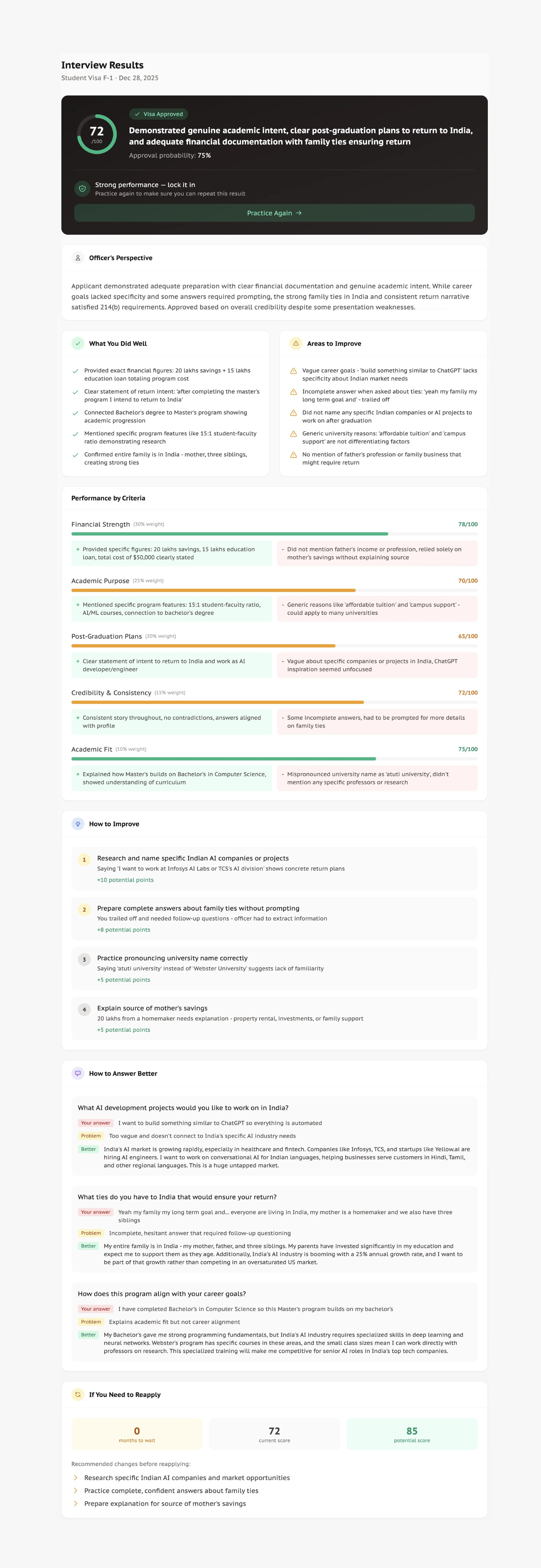
Get Detailed Feedback
After each session: overall score, category breakdown (clarity, confidence, preparedness), strengths, areas to improve, and a full transcript with specific recommendations.
AI Mock Interview vs. Other Preparation Methods
| Method | Real-Time Response | Follow-Up Questions | Feedback | Cost |
|---|---|---|---|---|
| Permito.ai | Detailed | 1 free, then $29 for 10 | ||
| Immigration Consultant | Varies | $200-500/session | ||
| Friends/Family | Limited | Subjective | Free | |
| YouTube Videos | None | Free | ||
| Question Lists | None | Free |
For a deeper comparison of AI tools, see our review of the best AI mock interview tools for 2026.
See it for yourself — free
1 free practice interview. No credit card. Takes 5 minutes.
What questions will the officer ask for your visa type?
Officers don't have a secret list of trick questions. The same themes come up again and again. Every question is really asking one thing: "Are you coming back?"
"Why did you choose this university?"
They want specific reasons — faculty expertise, research opportunities, unique programs. Not generic praise about rankings. Spoiler: "because it's a good university" is not the answer they want.
"What are your plans after graduation?"
Trap alert
Testing immigrant intent. Focus on career plans in your home country. Mentioning OPT or H-1B is a red flag that gets 214(b) fast.
"Who is sponsoring your education?"
Know exact figures: total cost, sponsor's income, source of funds. Vague answers kill applications. Be ready to explain any large recent deposits. Use our F-1 financial questions guide for detailed prep.
"Why not study in your home country?"
Have a specific answer about programs, faculty, research facilities unavailable domestically. For MS CS applicants, see our CS-specific interview guide. MBA applicants: MBA interview guide.
"What does your company do?"
Know your employer's business, revenue, employee count, major clients. Officers assess job legitimacy — vague answers suggest fake positions. See the full H-1B interview guide.
"Describe your daily responsibilities."
Speak from genuine experience, not from the LCA or job posting. Officers want natural speech about your actual work — reciting bullet points triggers suspicion.
"Did you pay for this job or visa?"
Critical question
The answer must be "No." Employers are legally required to pay all H-1B filing fees. If you paid, that's a violation.
"Why can't an American do this job?"
Focus on your specific qualifications — specialized skills, unique experience, advanced degrees. Don't criticize American workers. If you're stamping in India, read our Hyderabad stamping guide.
"What is the purpose of your visit?"
Be specific: attending a wedding, a business conference, visiting Disneyland with family. "Just traveling" invites probing. Parents visiting children: read our B2 parents guide.
"How long will you stay?"
Have a concrete answer with return date. "2 weeks for my cousin's wedding, returning March 15" beats "maybe a month or two." Extended or vague durations raise flags.
"Do you have family in the US?"
Disclose honestly — concealment gets detected and destroys credibility. Emphasize your independent reasons for returning: your job, your own family, property you own.
"What will bring you back home?"
Concrete ties: job waiting for you, spouse and children, business to run, property you own. The more specific and verifiable, the stronger your case.
What's changed for US visa interviews in 2026?
A lot. Over a dozen major policy changes since January 2025. Four of them land on your interview directly.
Interview waivers eliminated for most visa types
The COVID-era dropbox/interview waiver program was systematically dismantled in 2025. As of October 1, 2025, only B1/B2 and H-2A renewals (within 12 months, strict conditions) retain waiver eligibility. All H-1B, L-1, F-1, J-1, O-1, and M-1 applicants — including renewals — must attend in-person interviews. Age exemptions for children under 14 and adults over 79 were eliminated.
Used dropbox last time? You're facing an officer this time. Not a formality.
Social media screening expanded
Since June 2025, F, M, and J visa applicants must set social media profiles to "public." Since December 15, 2025, this expanded to H-1B and H-4 applicants. Officers review content going back 5 years for inconsistencies with your application, political activism, or content that raises security concerns.
Audit your accounts. Don't panic-delete — immigration attorney Benjamin Green: "If an officer sees a wiped phone or a device without any social media, that does not suggest there is nothing to hide. It raises further questions."
DS-160 barcode matching required
Since April 7, 2025, your printed DS-160 confirmation page barcode must exactly match the one used to schedule your appointment. Mismatches mean you don't get in. Many embassies now require DS-160 submission 48-72 hours before the interview.
Match the barcode to your appointment, print a fresh copy the night before, and don't touch the DS-160 after scheduling unless you rebook.
India B1/B2 refusal rate surged 35%
India's B1/B2 refusal rate jumped from 16.32% in FY2024 to 22.04% in FY2025. For context, Nigeria is at 57%, Bangladesh at 61%, and Pakistan at 52%. The worldwide B1/B2 refusal rate is 27.8%.
A year ago 16 in 100 Indian visitor applicants were refused. Now 22. Bring more proof of ties than you think you need.
India consulate wait times shifted dramatically
On 17 September 2026 the next available B1/B2 slot ran Kolkata 6.5 months, Chennai 7.5, New Delhi 10, Mumbai 11.5, Hyderabad 12 — five and a half months of spread for the exact same visa, and you may book any of them regardless of where you live. Students should read that list backwards: Chennai was under two weeks for F-1 while everywhere else sat at 1.5–2.5 months. Compare the posts in our Mumbai vs Delhi guide, and check the current number at travel.state.gov before you plan around it.
"If you're planning international travel or visa renewal, don't assume you're eligible for interview waiver processing anymore. The State Department is ending waiver eligibility for most visa categories, including H-1B, L-1, F-1, and J-1."
What does a 7-day preparation plan look like?
This assumes you've already completed your DS-160 and gathered documents. If you haven't, add 1-2 weeks.
Days 7-5: Documents & Research
Days 4-3: Practice Answers
Interview Day
Frequently Asked Questions
Three minutes, and most of it is decided before you speak
Two to three minutes. That's the entire thing, and it decides a degree, a job, or whether you see your daughter this year. I still find that slightly absurd.
Here's what I see in our data every day, though. The people who get approved aren't calmer by nature. They're the ones who already heard themselves answer these questions badly — once, somewhere that didn't count — and fixed it before it did.