
Rahul Sharma walked out of the US Consulate in Mumbai on December 13, 2025, holding a pink 214(b) rejection slip. His F1 application was done. Or so he thought.
Twelve days later, at the Chennai Consulate, he walked out with an approved visa.
Same questions. Same documents. Completely different outcome.
What changed? Not his credentials — same 8.2 CGPA from VIT Vellore, same I-20, same ₹45 lakhs in the bank. What changed was how he answered.
This is what happened.
Mumbai Consulate — Rejected
214(b) denial after 90-second interview
Analysis & Discovery
Found Permito.ai, started practicing
Intensive Practice
8 AI mock interviews over 9 days
Chennai Consulate — Approved
Same questions, confident answers
*Name changed for privacy. Rahul shared his story with us after getting approved.
Been rejected? Practice with AI that catches weak answers before the real officer does.
Try Free PracticeWhat went wrong at the first interview?
Everything. Rahul gave textbook answers to every question — technically correct, zero personality. The officer heard the same generic lines for the hundredth time that day and handed him the pink slip in 90 seconds.
Rahul's Background
On paper, solid candidate:
Admit from Arizona State for MS in Computer Science. Father — senior manager at Tata Steel, sponsoring. Everything looked solid.
How He Prepared (The Wrong Way)
Like most students, Rahul prepared by:
- Reading 100+ questions from visa forums
- Memorizing "perfect answers" from YouTube videos
- Practicing with his roommate (who had never been to a visa interview)
- Wearing a formal suit to "look professional"
He felt ready. He wasn't. (For a proven approach, see our complete visa interview preparation guide.)
The 90-Second Interview
Here's what happened at the Mumbai Consulate:
Officer: "Why do you want to study in the US?"
Rahul: "US has the best education system in the world."
❌ Generic answer, no specificity
Officer: "Why Arizona State?"
Rahul: "It's a good university with strong CS program."
❌ Could apply to any university
Officer: "What will you do after graduation?"
Rahul: "I will come back to India."
❌ No explanation of why or what he'd do
Officer: "Who is sponsoring you?"
Rahul: "My father."
❌ Didn't mention his job, income, or how funds were accumulated
Officer handed him the 214(b) slip without asking another question.
Total interview time: approximately 90 seconds. Officers process 10–12 applicants per hour. They don't have time to dig for your story — you have to hand it to them.
"They must make a decision, primarily, based on impressions formed during the first minute of the interview. What you say first and the first impression you create are critical to your success." — Gerald Wunsch, former US consular officer, NAFSA
"I answered every question. Didn't lie about anything. What the hell did I do wrong?"
What mistakes got him rejected?
Three things. Short robotic answers. Zero mention of ties to India. Incomplete financial story. That's the 214(b) trifecta — the shape of most F1 refusals.
Short, Robotic Answers
Every answer was technically correct but gave the officer nothing. "US has the best education" could be said by anyone. It revealed nothing about Rahul's genuine motivation.
Officers hear memorized answers all day. What gets through is a real reason with a real detail attached — not the textbook version.
Zero Ties to India Mentioned
"I will come back" — but never explained why. No family obligations, no career plans in India, nothing tying him home.
214(b) assumes you're staying. A job offer, a family obligation, property, a career that only works in India — something the officer can picture pulling you back.
Incomplete Financial Story
"My father is sponsoring" tells the officer nothing. What does his father do? How was ₹45 lakhs accumulated? Is this sustainable for 2 years? The officer was left to assume the worst.
Officers see large balances and wonder if they're window-dressing. You need to tell the story of how the money was saved — not just show numbers.
I see this exact pattern in our F-1 mock interview data. Strong profiles, terrible presentation. The profile was never the problem.
Making these same mistakes?
Practice with AI that catches weak answers before the real officer does.
How did he fix it in 12 days?
He practiced speaking, not reading. 8 AI mock interviews, each one tearing apart weak answers until he could articulate his genuine story under pressure. Everyone gets interview nerves — Rahul needed to burn through his before the real thing.
Day 1-2: Finding the Real Problem
Scrolling through Reddit's r/f1visa at 2am, Rahul found a post that changed his perspective:
"officers dont care about your profile. they care if you sound like youre lying. practice speaking out loud not typing answers"
He needed to practice speaking, not just reading. But practicing with friends felt awkward — they didn't know what questions to ask or how to push back on weak answers.
He went through our F1 visa question bank to know what to expect, then googled "visa mock interview" at 3am. Found Permito.ai.
Day 2: First Mock Interview
Brutal. He answered the same way he did in Mumbai — and the AI didn't let him off easy. (Nobody likes hearing their answers suck.)
AI Officer: "Why Arizona State specifically?"
Rahul: "It's ranked well and has a good CS program."
AI Officer: "Okay, but what specifically about their CS program interests you? What professors? What research areas?"
Rahul: "Um... they have machine learning courses..."
AI Officer: "Many universities have machine learning. What makes ASU different for your goals?"
Rahul: "..."
He had nothing.
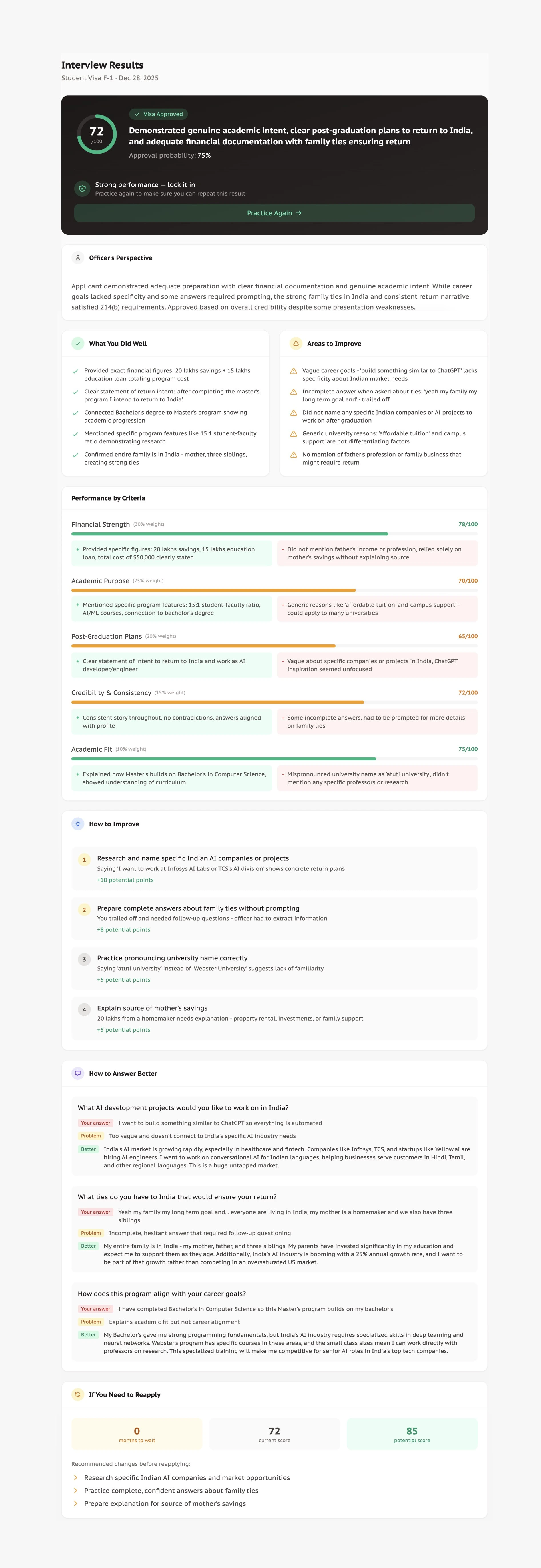
What the AI flagged:
- Vague university choice — couldn't name specific professors, labs, or unique programs
- No return intent — "I'll come back" without any concrete reason
- Incomplete financial narrative — numbers without context feel suspicious
- Rehearsed tone — sounded memorized rather than genuine
Days 3-10: Grinding
7 more mock interviews over 8 days. Not fun, but necessary.
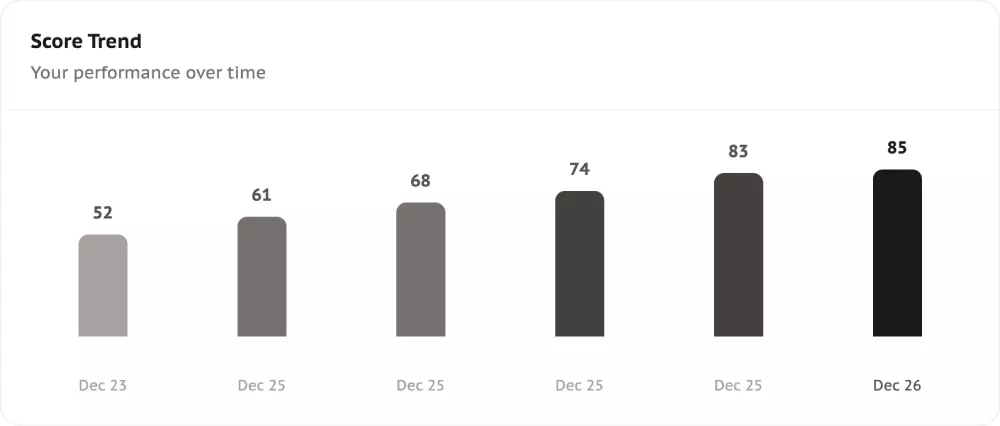
Rahul's Practice Log
Session 1
Baseline — identified all weak points
Sessions 2-3
Focused on "Why ASU?" — researched specific professors
Sessions 4-5
Worked on ties to India — articulated career plans
Sessions 6-7
Financial story + addressing previous rejection
Session 8 — Final practice
Full mock interview, all improvements integrated
The Answers He Developed
"Why do you want to study in the US?"
Before
"US has the best education system in the world."
After
"Specifically for Professor Kambhampati's AI lab at ASU. His work on human-AI collaboration is exactly what I want to research, and their Luminosity Lab offers industry projects I can't find in India."
Note: Just dropping a professor's name doesn't work — officers hear that trick daily. Rahul could actually explain what Kambhampati researches and why it matters to him. If you can't answer follow-ups about "your" professor, don't mention one.
"What will you do after graduation?"
Before
"I will come back to India."
After
"Return to India — my father's colleague at Tata Steel is building their AI division and wants me on the team. The AI market in India is growing fast, better opportunities there for me than competing in the US."
"Who is sponsoring your education?"
Before
"My father."
After
"My father — he's a senior manager at Tata Steel, 22 years. The 45 lakhs has been saved over many years, he started when I was in 10th standard. I can show the transaction history."
Day 11: One More Critical Addition
In his final practice session, the AI asked something he hadn't prepared for:
"I see you were denied a visa recently. What happened?"
This question terrified him. But the AI's feedback taught him: addressing the rejection head-on shows self-awareness and actually works in your favor.
His response:
"Yes, I was denied in Mumbai 12 days ago. I gave short answers without explaining my reasons — said 'I'll come back' but not why. The truth is, I have specific plans with Tata Steel's AI team and I researched ASU for Professor Kambhampati's lab. I just didn't communicate that clearly. Hoping to do better today."
What happened at the second attempt?
Approved. Same questions, completely different answers. The officer smiled and wished him good luck.
December 25, 2025. Chennai Consulate. 10:30 AM slot.
Rahul wore a simple polo shirt and chinos — no suit this time. He felt calm. Not because he was confident in approval, but because he knew exactly what he wanted to say.
The Interview
Officer: "I see you were denied recently in Mumbai."
Rahul opened with his prepared acknowledgment — honest, self-aware, specific about what he'd do differently.
✓ Addressed the elephant in the room immediately
Officer: "Why Arizona State?"
Rahul mentioned Professor Kambhampati by name, described his specific research interest in human-AI collaboration, and explained how ASU's Luminosity Lab fit his goals.
✓ Specific, researched, genuine enthusiasm
Officer: "What will you do after?"
Rahul explained the Tata Steel AI division opportunity, mentioned his father's colleague by role (not name), and noted that India's AI market growth made returning attractive professionally.
✓ Concrete tie, specific opportunity, logical reasoning
Officer: "How is your father affording this?"
Rahul explained the 22-year career at Tata Steel, the salary, and crucially — that savings had been accumulating since he was in 10th standard.
✓ Financial story with timeline, not just numbers
Officer smiled. "Good luck with your studies. Your visa is approved."
Total interview time: approximately 3 minutes.
Same questions. Different answers. Different outcome.
F-1 Visa Approved
12 days from rejection to approval
What's the takeaway?
Reading questions ≠ answering them. A strong profile means nothing if you can't communicate it in 90 seconds under pressure.
Now enrolled at ASU, Rahul boils it down to three things:
Reading questions ≠ answering them
"I had read hundreds of questions. Could recite perfect answers in my head. But standing at that window? Mind went blank. Reading is not the same as speaking out loud when someone's staring at you."
Authenticity beats perfection
"My second interview answers weren't 'perfect' — they were real. I mentioned my father's colleague, talked about one specific professor I actually researched, admitted my first rejection was my fault. Officers notice when someone sounds like an actual human."
A rejection is not a death sentence
"I was devastated after Mumbai. Thought my chances were over. But it wasn't about my profile — it was about how I presented myself. Fixed that in 12 days."
"Officers don't look for mistakes. They look for clarity. Thorough preparation creates confidence."
"Don't wait until you're at that window to find out how you sound under pressure. Find out before. That's it."
Frequently Asked Questions
Your Story Could Be Next
We see this constantly in our data. Strong profiles, weak answers, pink slips. Same pattern, over and over.
The fix isn't complicated. Practice speaking, not reading.
Practice Speaking
AI mock interviews simulate real pressure. Find out how you actually sound under stress.
Get Feedback
Know exactly what weak points to fix. See your score improve with each session.
Walk In Confident
When you've answered every question 10 times, the real interview feels easy.