
What you've heard
- "Any gap means automatic rejection"
- "More than 3 backlogs = no visa"
- "70% rejection rate for gap applicants"
What's actually true
- No government publishes gap-specific data
- 70-80% of Indian engineering students have backlogs
- Your explanation decides the outcome, not the gap
Here's the panic cycle: you have a 2-year gap after graduation, or 6 KTs on your transcript, and every forum post screams "you're done." You're not. Probably.
The F-1 refusal rate hit 35% worldwide in 2025 — highest in a decade, and 61% for Indians. But that's all applicants. Every "70% rejected with gaps!" stat you've seen on Reddit comes from education consultants selling courses, not from actual data. No government — not USCIS, not the State Department, not IRCC — publishes rejection rates by education gap.
Your job isn't to hide the gap. It's to make the officer understand it. And that's a learnable skill.
Have a gap or backlogs? Practice your explanation.
The AI officer will ask follow-ups — exactly like the real interview.
Do gap years and backlogs actually cause visa rejections?
Short answer: no. A gap is a signal, not a death sentence.
Dan M. — former consular officer, 50,000+ visas in Tijuana and Dublin — put it bluntly: a red flag just means "ask more questions." That's it. Officers aren't hunting for reasons to reject you. They're trying to understand your story.
"Gaps in experiences appear as flagged items that may prompt follow-up questions. But a red flag is not always a refusal — it is a signal to the officer to ask more questions. Officers are trained to identify patterns. They're searching for clarity, not for mistakes."
Eric Morin — retired FSO, 70,000+ visas, 10 embassies — was more specific. Short gaps? Nobody cares. Five years or more? That "prompts serious questioning." Not rejection. Questioning.
Big difference. 1-year gap for GRE prep? Routine. 5-year gap with zero documentation and a panicked "I was... uh... exploring options"? That's where you lose them.
278,000 F-1 denials in 2024. Most were 214(b) — the officer wasn't convinced the applicant would return home. Not because they had gaps. Because their story didn't hold together.
What Actually Drives F-1 Visa Rejections
Weak ties to home, vague career plan, unconvincing finances
Gaps don't reject you — a fumbled explanation of your gap does, because it weakens the 214(b) assessment
Fix the narrative and the gap stops mattering.
What are acceptable explanations for a study gap?
Almost anything — if it's honest and you can back it up. Here's the formula every immigration expert agrees on: acknowledge → explain briefly → show what you did → connect to your program. 15-20 seconds when you've practiced it. That's it.
Work experience
Strongest card you can play. "I worked as X at Y for Z years, realized I needed [specific skill], and that's why I'm here." Shows direction, not drift. Bring employment letters.
Competitive exam preparation
UPSC, GATE, CAT, GRE — officers know Indian applicants do this. Mention what you gained, even if you didn't clear the exam. "I prepared for CAT for 8 months. That analytical grind is exactly why I chose this MS in Data Science." Bring scorecards.
Family responsibilities
Keep it brief. Zero drama. "My father had health issues, I managed the family business for a year." Don't over-explain, don't get emotional. Document if possible. Move on.
Health reasons
Even shorter. "I had a medical condition, fully recovered, ready to study." Bring documentation but don't volunteer details unless asked. Seriously — don't.
COVID period (2020–2022)
Still works, but getting stale — every officer heard it a thousand times in 2021 and 2022. "COVID happened" alone won't cut it in 2026. What did you do during lockdown? Coursera certs, freelance work, family business? Show something productive.
How do you explain a gap of 5+ years?
This is where people lose it. Five years is a lot of blank space to explain in a 2-3 minute interview.
Morin flagged this specifically — long gaps "prompt serious questioning." The officer needs to see progression. Not stagnation. Not "I was figuring things out."
The trick: break it into chapters. Nobody questions a 6-year gap when each year has a name.
Example: 6-year gap, broken into chapters
Six years. But each year is accounted for. Each step connects to the next. The story progresses.
What kills long-gap applications: mysterious holes. "I was just... around" is not an answer. Fill every year with something — even modest. And bring the documentation to back it up.
I see this constantly in our AI mock sessions: applicants with 5+ year gaps who break their timeline into chapters score way higher on confidence than those who try to summarize six years in one rambling sentence. Structure beats eloquence every time.
How do backlogs affect your visa interview?
Here's what nobody on Reddit tells you: most officers have no idea what Indian backlogs even are.
KT. ATKT. Arrears. Year drops. These words mean nothing to the person on the other side of the glass. Mumbai Uni calls them "KT," Anna University says "arrears," VTU says "backlogs" — and the American officer staring at your transcript has never heard any of it.
Indian Backlog System — Decoded
Some context: most first-year Indian engineering students pick up at least one backlog, and first-year maths is the usual culprit. It isn't a rare failure — it's how the system works.
IDP Education says it directly: backlogs generally don't affect visa processing if the university accepted you. The admission stage is where they mattered. The visa stage? Intent, finances, ties to India.
But — if your transcript has "Fail" marks and the officer notices, they'll ask. And if you freeze up and start stammering, that becomes the red flag. Not the backlog. The panic.
Have a backlog certificate ready. If it comes up: "Backlogs are very common in Indian engineering — most students pick up a few in the early semesters. I cleared all of mine and graduated on time." Done. Move on.
What do strong gap explanations actually sound like?
You've read the theory. Now try saying an answer out loud. Right now. Without looking at notes.
...Harder than you expected? Good — that means you need this section.
2-year work gap
"Why is there a 2-year gap after your bachelor's?"
"I worked as a software developer at TCS for two years after graduation. The role was good, but I hit a ceiling — I needed advanced skills in machine learning that my B.Tech didn't cover. That's exactly why I'm pursuing this MS in Computer Science at [university]."
"What specific projects did you work on at TCS?"
↑ Typical follow-up. You MUST know your job details.
COVID gap (2020–2021)
"What were you doing during 2020–2021?"
"The pandemic delayed my plans by about a year. During that time, I completed three Coursera certifications in data analytics and worked part-time at my family's business. I started GRE prep in mid-2021."
COVID alone won't cut it. Show what you DID.
Backlogs on transcript
"I see some failed subjects on your transcript. Can you explain?"
"Indian engineering universities have very high failure rates in early semesters — around half of students get backlogs in math alone. I cleared all of mine by third year and graduated on time. My GRE score of 322 reflects my current ability better than early-semester marks."
"How many failed subjects exactly?"
↑ They want a number. Give it calmly. Don't dodge.
Family responsibility + career pivot
"Why didn't you pursue a master's immediately after graduation?"
"My father was diagnosed with a cardiac condition in 2022. I managed the family's retail business in Pune for a year while he recovered. He's stable now, my younger brother has taken over. That experience — running inventory, managing staff — is actually part of why I chose an MBA in operations management."
Every gap connects to the program. That's the pattern.
Brief, honest, forward-looking. No defending, no monologues. The officer hears a story that holds, and moves on.
Reading scripts is easy. Saying them under pressure isn't.
Practice your gap explanation with an AI officer who asks real follow-ups.
What documents strengthen a weak academic profile?
Documents don't get you approved — your answers do. Reddy Neumann Brown PC nailed it: "The most important thing is how you answer questions during the interview." Docs are backup. But good backup matters.
Must have
- Gap certificate — sworn affidavit on ₹100–₹500 stamp paper, notarized (takes 2-3 days)
- Employment certificates for every job during the gap
- Backlog certificate from university (if applicable)
Bring if relevant
- Competitive exam scorecards (GRE, GMAT, GATE, CAT)
- Course completion certificates (Coursera, edX, etc.)
- Medical documentation for health gaps (bring, don't volunteer)
And please — don't bring 47 papers in a jumbled folder. Organize chronologically. If the officer asks about 2021, you should pull out that certificate in 5 seconds. Not dig through a stack. See our interview day guide for how to organize everything.
What mistakes turn a gap into a rejection?
The gap itself is rarely the problem. These are:
Inconsistencies
Your DS-160 says you worked at Company X from 2020–2022. In the interview, you say 2019–2021. Small discrepancy, huge problem. Officers see your DS-160 on screen. Everything must match.
Sounding rehearsed
"Sir, after completing my bachelor's degree in 2019, I decided to gain valuable industry experience..." Stop. That sounds like you memorized a script from a YouTube video. Just talk normally.
Getting defensive
Officer asks about your gap. You start justifying, over-explaining, talking too fast. You sound like you're hiding something. Acknowledge → explain → move on. 15-20 seconds, tops.
The "eternal student" pattern
B.Tech → failed GATE → worked 1 year → failed CAT → now applying for MS. Officers see someone collecting qualifications without direction. If this is your profile, you need a clear narrative connecting all these dots into one coherent career path.
Unexplained periods
Every month between graduation and now should be accounted for. "I was preparing for exams" is fine. A mysterious 8-month void with no answer? That's the red flag — not the gap.
Yvette Bansal (40,000+ visas) summed up the real red flag: not having a story where everything fits together. Gap or no gap — if your narrative has holes, you have a problem. Our F1 interview guide covers how to build that narrative from scratch.
How do you practice explaining your gap with Permito?
Okay. You've read the scripts. You know the red flags. Now try saying your gap explanation out loud. Right now. Without looking at notes.
Stumbled? Added three sentences you didn't need? Yeah.
"Many people fail their visa interview because they don't know how to communicate effectively with the Visa Officer, not because they don't qualify."
Reading about gaps and explaining them under pressure — completely different skill. Your brain works differently when someone is staring at you through a glass window, deciding your future in 90 seconds.
That's why I built Permito to push on exactly these weak spots. Mention a gap? The AI doesn't nod politely and move on — it does what real officers do:
Asks follow-ups based on YOUR answers
"You said you worked during the gap — what exactly was your role?"
Catches inconsistencies
If your timeline doesn't add up, the AI will probe — just like a real officer would.
Gives detailed feedback
Where you sounded defensive, where you over-explained, where your story broke down.
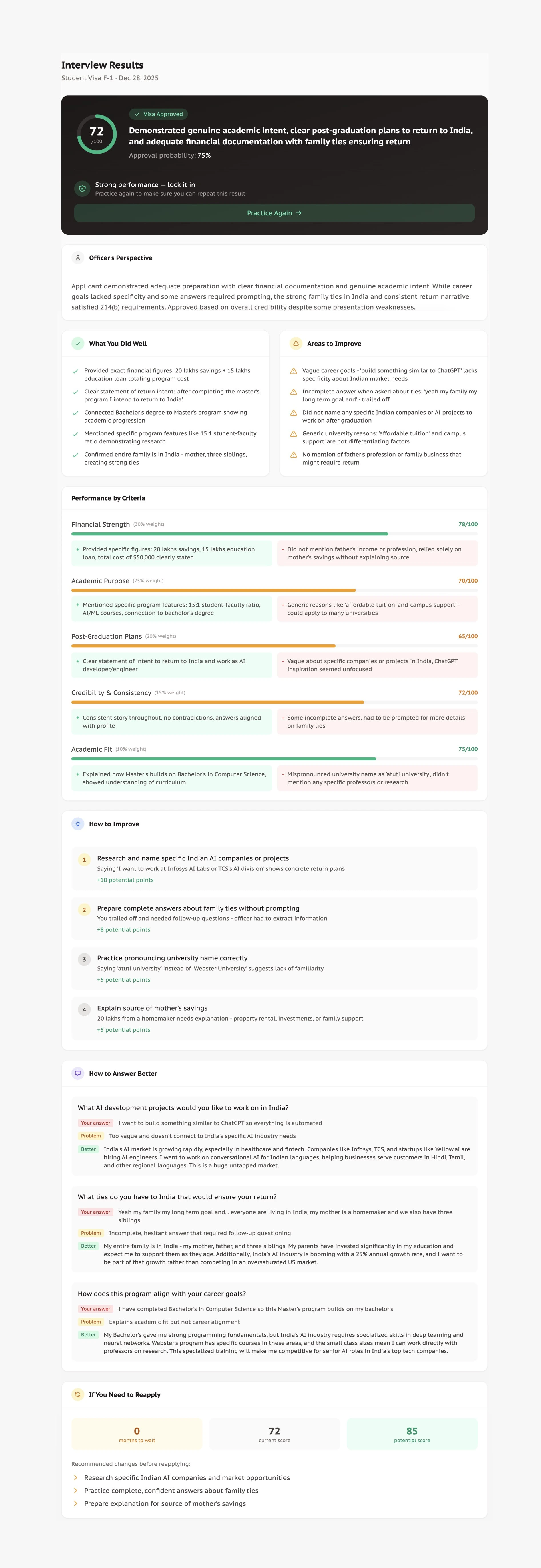
Most people need 5-10 sessions before their gap story sounds natural instead of rehearsed. That's the gap between reading a script and owning it. Check our question bank for everything else officers throw at you.